
Say goodbye to JavaScript Date... Let's talk about Temporal!

If you have ever worked with JavaScript dates and found yourself wondering whether you were the problem, I have good news: it might not be you.
JavaScript’s Date object has been around forever, and while it kinda works for many things, it clearly was made with no particular good plan in mind (well, story of JavaScript as a whole to be fair).
Parsing weird strings, dealing with timezones, adding days and somehow landing in the wrong hour because of daylight saving time... you know the struggle. Date has always had a special gift for turning apparently simple tasks into tiny acts of betrayal.
And that is exactly why Temporal feels so refreshing. It is a modern JavaScript API built to handle dates, times, durations, and timezones with much clearer boundaries, which already makes the whole thing feel a lot less absurd.
First of all, what is Temporal?
Temporal is a newer JavaScript API for working with dates, times, durations, timezones, and all those lovely things that Date has never handled particularly well.
The idea for Temporal is not exactly brand new either.
As the article Temporal: The 9-Year Journey to Fix Time in JavaScript (Opens in a new tab) by Jason Williams (Opens in a new tab) (via Bloomberg Engineering (Opens in a new tab)) mentions, Maggie Johnson-Pint (Opens in a new tab) brought the original proposal to TC39 in 2017 as an attempt to finally address the long-standing pain around JavaScript dates, and over the years the proposal was shaped further by a broader group of contributors including Philipp Dunkel, Matt Johnson-Pint, Brian Terlson, Ujjwal Sharma, Philip Chimento, Jason Williams, Justin Grant and others (Opens in a new tab).
In other words, this was not a random API refresh that appeared overnight, but a fairly long effort to rethink how JavaScript should deal with time in the first place.
If you are curious about how these things make their very slow way into the JavaScript we actually get to use, Temporal: The 9-Year Journey to Fix Time in JavaScript (Opens in a new tab) by Jason Williams (Opens in a new tab) via Bloomberg Engineering (Opens in a new tab) has already written a much better intro to that journey than I could here, and it is well worth a read.
Unlike Date, Temporal is not just one overloaded object trying to do everything at once. Instead, it splits responsibilities into different types, each designed for a specific purpose:
- if you only care about a calendar date (e.g. birthday), there is a type for that
- if you care about an exact moment in time, there is a type for that too
- if you need to handle timezones properly, yes, there is finally a type for that as well
Compare dates? Add days to a date? Temporal handles all that much more gracefully too.
Why is Date such a pain?
The problem with Date is not that it is bad. The problem is that it tries to do too many things at the same time. A Date can act like a timestamp, a local date and time, a UTC date and time, something you parse from a string that may or may not behave as expected depending on format and environment...
... which means that when you work with it, you are often juggling concepts that should have probably stayed separate, or worse, you are forgetting said concepts.
On top of that, there are a few classic annoyances:
- months are zero-based
- setters mutate the original object
- timezones are awkward and limited
- date arithmetic can get weird very quickly
- parsing is not always as predictable as you would hope
And if that still sounds a bit abstract, here are two tiny examples of the kind of nonsense people end up dealing with.
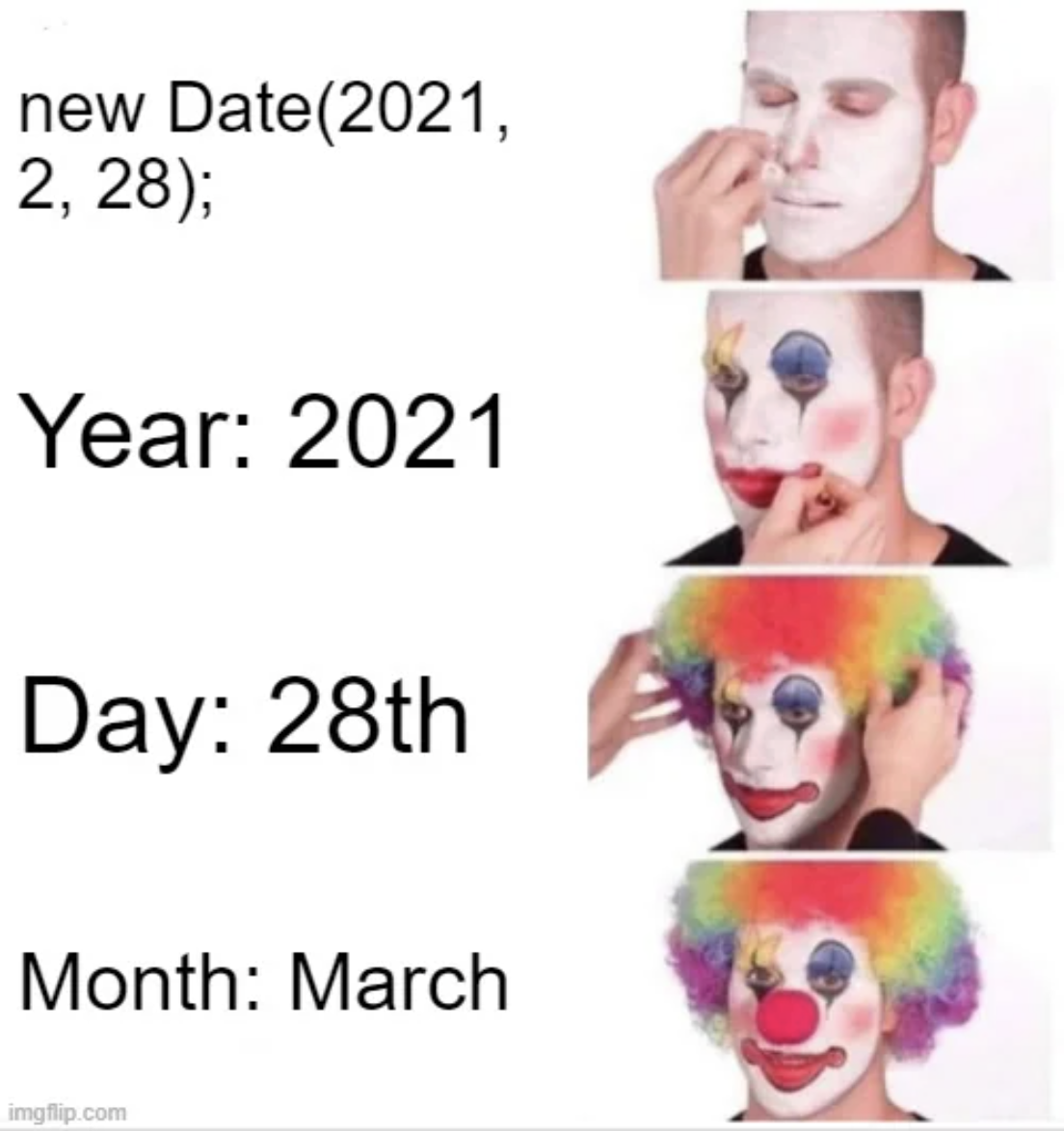
new Date(2021, 2, 28) unexpectedly produces March 28th instead of February 28th.
Source: Working with Date objects in JavaScript (Opens in a new tab) on r/ProgrammerHumor (Opens in a new tab)
First, months being zero-based. Why?! Like, if you look at the documentation you see the big discrepancy:
1new Date(year, monthIndex, day, hours, minutes, seconds, milliseconds)
And you can't tell me that it's easy to know that the 1 here
1 2 3const myDate = new Date(2026, 1, 15); console.log(myDate.toDateString()); // Thu Feb 15 2026
stands for February, not for January. It is the kind of thing you forget, re-learn, eventually memorize, and never quite forgive.
Then there is month arithmetic:
1 2 3 4const billingDate = new Date('2026-05-31T00:00:00Z'); billingDate.setMonth(billingDate.getMonth() + 1); console.log(billingDate.toISOString()); // 2026-07-01T00:00:00.000Z
If your intention was just “one month later”, Date clearly had other ideas.
This is the kind of thing that makes you trust Date a little less every time.
This is exactly where Temporal comes in and tries to clean up the mess.
Temporal’s biggest strength: a proper separation of concerns
Instead of one catch-all object, Temporal gives you multiple objects with more focused purposes.
As MDN’s Temporal API overview (Opens in a new tab) breaks it down, the API includes:
Temporal.DurationTemporal.InstantTemporal.ZonedDateTimeTemporal.PlainDateTimeTemporal.PlainDateTemporal.PlainYearMonthTemporal.PlainMonthDayTemporal.PlainTimeTemporal.Now
And that is just the object map! Temporal also gives you a fairly generous set of methods and helpers for working with time values more explicitly. Across its different objects, you get something like:
- construction:
from(),fromEpochMilliseconds(),fromEpochNanoseconds() - current values (through
Temporal.Now):instant(),zonedDateTimeISO(),plainDateISO(),plainDateTimeISO(),plainTimeISO() - comparison:
compare(),equals() - updates:
with(),withCalendar(),withTimeZone(),withPlainTime() - arithmetic:
add(),subtract(),since(),until() - rounding:
round() - serialization:
toString(),toJSON(),toLocaleString(),valueOf() - conversions:
toInstant(),toZonedDateTime(),toPlainDate(),toPlainDateTime(),toPlainTime()
That already feels far more structured than anything Date ever offered.
Temporal.Instant: for when you need the exact point in time
If you need an exact, unambiguous moment in history, that is where Temporal.Instant comes in. This is especially useful when dealing with timestamps coming from APIs, databases, or event logs, because what you usually want there is not “whatever local time this turns into on my machine”, but the exact moment something happened.
(This is also where we should make an important distinction in the way we articulate our work, because a lot of values that we casually call dates are not really like dates in the human sense but rather machine-level points in time).
For example:
1 2 3const instant = Temporal.Instant.from('1969-07-20T20:17Z'); instant.toString(); // => '1969-07-20T20:17:00Z' instant.epochMilliseconds; // => -14182980000
With Date, this kind of value tends to get mixed together with local interpretations very quickly. With Temporal.Instant, the intent stays much cleaner: this happened at this exact moment in time, that's it.
Temporal.PlainDate: for when you just need a date
On the very opposite end, sometimes, you do not care about the time of the day; sometimes, you do not care about the timezone of the user...
...sometimes, you just want a date.
It is very common to ask users about their birthday, and that is the one case where the time and timezone that Date implicitly offers are often at odds with the developer’s actual intent. This is where Temporal.PlainDate comes in.
1 2 3 4const articleDeadline = Temporal.PlainDate.from('2026-05-10'); console.log(articleDeadline.toString()); // 2026-05-10
Lovely, simple, clean.
And because Temporal objects are immutable, if you add something to a date, you get a new value instead of silently mutating the old one.
1 2 3 4 5 6 7 8const articleDeadline = Temporal.PlainDate.from('2026-05-10'); const postponedDeadline = articleDeadline.add({ days: 3 }); console.log(articleDeadline.toString()); // 2026-05-10 console.log(postponedDeadline.toString()); // 2026-05-13
I am personally very fond of APIs that do not surprise me with side effects (who isn't), so this is the biggest win that Temporal brings for me.
Oh and by the way, the Date month arithmetic we tried to do before?!
1 2 3 4 5const billingDate = Temporal.PlainDate.from('2026-05-31'); const nextMonth = billingDate.add({ months: 1 }); console.log(nextMonth.toString()); // 2026-06-30
Which, for once, feels like the result you meant to ask for.
Temporal.ZonedDateTime: for when timezones actually matter
Let’s not forget our best friends: timezones. Yes, they do matter more often than we would like to admit.
If you are scheduling meetings, launches, reminders, in general any events for users in different regions... then using something time-zone-aware is kind of important.
Temporal.ZonedDateTime represents a date and time in a specific timezone.
1 2 3 4 5 6 7 8 9 10 11const meeting = Temporal.ZonedDateTime.from({ year: 2026, month: 5, day: 10, hour: 15, minute: 30, timeZone: 'Europe/Helsinki' }); console.log(meeting.toString()); // 2026-05-10T15:30:00+03:00[Europe/Helsinki]
This is the kind of thing that Date has always made feel more mysterious than it should.
One particularly useful point from the Temporal docs is that timezones are not just offsets, they are rules. And those rules change. Daylight saving time exists, political decisions happen, chaos thrives, and fixed offsets do not always protect you from that.
That is why using a real named timezone like Europe/Helsinki is much safer than relying on something like +03:00.
Temporal.PlainDateTime: for when you want a date and time, but not a timezone
Sometimes you do want both the date and the time, but you do not want to anchor that value to a specific region yet.
That is what Temporal.PlainDateTime is for.
Think of things like a reminder at 09:00 or store opening times that are meant to stay local.
That kind of wall-clock value is different from an exact global timestamp, and Temporal is refreshingly explicit about that.
There are other Temporal objects too, like `Temporal.PlainTime`, `Temporal.PlainYearMonth`, and `Temporal.PlainMonthDay`, and they absolutely have their purpose, especially when you want to represent more specific kinds of date or time values without forcing them into a full timestamp. But if we are talking about the objects that will probably feel immediately simpler and more useful than `Date` for most people, I think `Instant`, `PlainDate`, `PlainDateTime`, `ZonedDateTime`, and `Duration` are the real starting point.
Temporal.Duration: for representing lengths of time
Another useful concept that Temporal handles clearly is duration. A duration is not a date, not a time, but it is just an amount of time.
For example:
1 2 3 4const writingSession = Temporal.Duration.from({ hours: 2, minutes: 30 }); console.log(writingSession.toString()); // PT2H30M
You can use durations for arithmetic too:
1 2 3 4 5 6 7 8 9const subscriptionStart = Temporal.PlainDate.from('2026-05-10'); const trialPeriod = Temporal.Duration.from({ days: 14 }); const trialEnd = subscriptionStart.add(trialPeriod); console.log(trialPeriod.toString()); // P14D console.log(trialEnd.toString()); // 2026-05-24
That does not mean all duration math suddenly becomes trivial, of course. A month does not always have the same number of days, and a day is not always exactly 24 hours when timezone transitions are involved. What I appreciate is that Temporal is much more explicit about that kind of context instead of quietly pretending everything behaves the same.
Why Temporal feels better
The more I read through it, the more Temporal feels like an API designed by people who have suffered enough through date handling to want something better.
With Date, I often feel like I am negotiating with the enemy; with Temporal, I feel much more like I am describing what I actually mean.
1. It is immutable
This is a big one.
With Date, this sort of thing is painfully easy:
1 2 3 4 5 6 7 8 9 10function addOneWeek(myDate) { myDate.setDate(myDate.getDate() + 7); return myDate; } const today = new Date('2026-05-10'); const nextWeek = addOneWeek(today); console.log(today.toISOString()); console.log(nextWeek.toISOString());
The problem here is not just that the code works in a surprising way. The problem is that it works in a surprising way quietly and it can be quite challenging to debug.
With Temporal, the intent is much clearer:
1 2 3 4 5 6 7 8const today = Temporal.PlainDate.from('2026-05-10'); const nextWeek = today.add({ days: 7 }); console.log(today.toString()); // 2026-05-10 console.log(nextWeek.toString()); // 2026-05-17
That kind of predictability is what saves real time and real frustration.
2. The types are more intentional
Instead of stuffing everything into Date, you choose the object that matches the problem.
That makes the code more readable, but it also forces you to think more clearly about what you are actually trying to represent.
If you are storing a birthday, a holiday, or a publication day, you probably want a calendar date, not a timestamp disguised as one. If you are storing an event log from an API, you probably want the exact moment something happened, not a vague local interpretation of it.
That difference is easy to blur with Date, because Date keeps trying to be all of those things at once. Temporal is better at forcing the right question first: what kind of time value am I actually dealing with?
3. Timezones are treated like a real concern
This is a bigger deal than it might sound at first.
With Date, timezones often feel like something you only notice once they have already caused a problem. Things look fine, until a meeting shows up at the wrong hour, a reminder fires too early, or a date shifts because one user is in a different region than another.
That is part of what makes date logic so frustrating: the bugs are often subtle, and they usually appear only once real people in real places start interacting with your product.
With Temporal, time-zone-aware values are first-class citizens. That means you can be explicit instead of clever.
1 2 3 4 5 6 7 8const meeting = Temporal.ZonedDateTime.from({ year: 2026, month: 10, day: 25, hour: 9, minute: 0, timeZone: 'Europe/Helsinki' });
That may not look revolutionary at first glance, but it really is. You are not faking a timezone through offsets, and you are not hoping daylight saving time will behave. You are saying exactly what the date means, in exactly which region, and letting the API carry that context properly.
4. Not just for the Gregorian calendar
Another part that deserves a mention is calendar support. Temporal is not limited to the Gregorian calendar only, which is a pretty big deal if you are building applications used across regions and cultures.
And this is not just about formatting a date differently. Different calendar systems can change how years, months, eras, and even the structure of dates are represented. So if your users expect dates to follow a specific calendar tradition, that is no longer immediately a guess I need a library for that moment.
For example, you can take a plain date and express it with another calendar system without needing a third-party library:
1 2 3 4 5 6 7 8const date = Temporal.PlainDate.from('2026-05-10'); const japaneseDate = date.withCalendar('japanese'); console.log(date.toString()); // 2026-05-10 console.log(japaneseDate.toString()); // 2026-05-10[u-ca=japanese]
The point here is not that the date suddenly looks dramatically different in this raw string form, but that the calendar system is now part of the value itself instead of being something you have to awkwardly glue on later.
5. It makes common date mistakes harder to make
A good API should not only let you do powerful things, it should also make the wrong things more difficult, and Temporal does that better than Date.
For example, months are 1-based instead of 0-based, which immediately removes one of the silliest footguns in JavaScript date handling. Parsing is also much more explicit, and arithmetic reads more like something a human being would actually write.
So yes, Temporal is broader than Date, but it also feels much less chaotic. It gives you more tools while making the most common mistakes a little harder to make.
So, should we all start using it?
I think it is worth learning now, even if you are not using it everywhere yet.
And while in another AI-free timeline we probably would have seen StackOverflow flooded with questions about all of this, the Temporal Cookbook (Opens in a new tab) already does a pretty good job of collecting the kinds of date-related problems developers have been asking for years and showing how Temporal handles them.
If your projects deal with scheduling, timezones, recurring events, user-facing dates, date math that needs to be reliable... then Temporal is definitely something you might want to migrate to.
But what about the libraries that exist nowadays?
And yes, if you are already using something like Day.js (Opens in a new tab), the obvious question is whether you should replace it with Temporal.
I would personally make the leap, but only after Temporal browser compatibility improves (Opens in a new tab).
Temporal has the advantage of being built around clearer concepts from the start, with first-class support for things that usually push people toward libraries in the first place. And I'm not trying to say Day.js bad, Temporal good, but more that Temporal is what we were supposed to have to begin with, and we probably should not have felt the need to build so many libraries around Date in the first place.
TL;DR
Date is old, overloaded, and a bit too messy for the kind of applications we build today.
Temporal gives us clearer types, immutable objects, better date arithmetic, proper timezone handling, less mistakes, non-Gregorian calendars and, more than anything, a significantly less insane way to think about time in JavaScript.
Will it solve every date-related headache instantly? Probably not. But will it make things much less cursed? I genuinely think so!
And honestly, about time! (yes, pun intended)